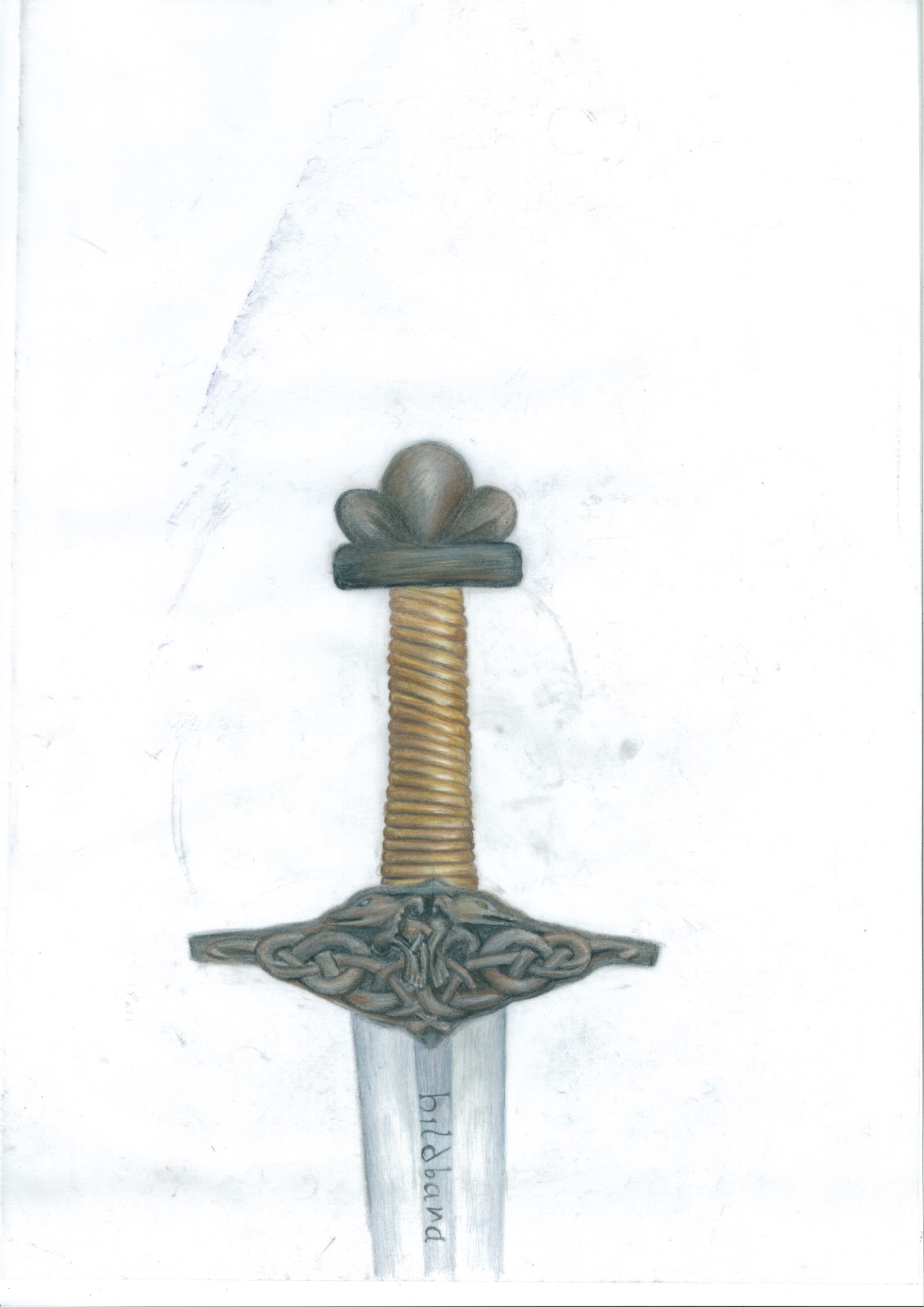
Wednesday, 24 October 2012

Excerpt Two From Sons of the Wolf


Now, at the head of his unit, Wulfhere was staring at the large volume of men as they spewed over the crest of the hill, gradually making their way down into the valley below. They were a formidable sight, Gruffydd’s army, as they formed their lines, some two thousand and more warriors ten or so men deep. Hwitegaast snorted and slammed his right hoof into the ground, scuffing the dirt to show his discontent. Wulfhere gave him a reassuring pat on his withers and sighed deeply.

“Scitte!” cried Esegar, mounted next to him. “There are so many of them.”

Wulfhere puffed out his cheeks and wondered how six hundred mounted men supported by one hundred or so bowmen and no more than three hundred and fifty infantry men were going to triumph over Gruffydd’s vastly larger host.

“Aye, there are indeed,” he agreed with a shudder, hoping that their cavalry would compensate for their lack of numbers.

“Lord, look to the left flank.” Esegar’s voice was shaking.

Wulfhere looked to where Esegar had indicated. “Hell has arrived,” he muttered under his breath.

There were at least eighteen hundred more men, Wykinga, coming round the side of the mound in the valley pass to join the main army as they marched toward them. Their steel helmets flashed as the mist cleared. Sharpened speartips bristled as they augmented the lines of Gruffydd’s men, shouting “Odin! Odin!” The noise was thunderous as they invoked their deity to make them triumphant, whilst the Welsh called out “Llaith at y Saeson!” “Death to the Englisc!”

Wulfhere felt his stomach bubbling. He heard Esegar’s sharp intake of breath.

“Lord, we were greatly outnumbered. Now we are severely outnumbered,” his fyrdsman said with a sardonic grimace.

As Wulfhere’s eyes squinted out over the daunting scene of so many armoured men stamping their way across the green fields toward them, he felt his face prickle with fear and, despite the cold, started to sweat. He breathed deeply, trying not to remember the horrors of Dunsinane.

Gruffydd himself had a smaller mounted force, his teulu, but the amount of heavily armoured Norse foot soldiers alone far outnumbered the entirety of Ralph’s force. He gulped his nausea down into his gullet. They needed to charge soon, for if they didn’t the whole purpose of them as a mounted force would be pointless. Horses are rendered useless in a defensive stance.

Oh my God, he thought to himself, there is going to be slaughter unless we charge now!

Excerpt One from Sons of the Wolf


Chapter Nineteen

The Battle of Hereford

Hereford, October 24th 1055

Ralph walked along the rampart of his palisaded defences as the chilled late autumn morning swathed the burgh in a cloak of mist. He was proud of his strong timber and earth castle that he had built inside the burgh of Hereford not long after his uncle King Edward had invested him with the office of earl four years ago. If he looked out over the parapet on a clear day, to the north of the burgh, he would be sure to see any sign of the enemy coming.

This morning would be like any of the other mornings that had passed since, upon hearing Burghred’s news, he had wasted no time in gathering his huscarles and racing across the ancient tracks to the West Country, sending out summonses to all the mounted men that Edward had commended to him. Looking out over the fog-laden hills, he contemplated another morning of watching and waiting. Down in the courtyard, his men would be on standby. He was proud of his accomplishments in Hereford and fiercely proud of the mounted cavalry he had trained. Some of the Englisc looked upon his ideas with derision, but he would show them just what his mounted army could achieve. He had stubbornly refused Harold’s offer to rally the Wessex fyrd to aid him, convincing everyone, except for Harold, that he had no need of them. This was not, he had said, a matter of national emergency. His mounted soldiers would be match enough for Alfgar and Gruffydd, he had guaranteed them.

“Another morning and still they do not come,” muttered William Malet, joining him in leaning against the wooden barrier. Dressed and ready for battle, the men wore their armour of little metal links skilfully chained together to form the hauberk, the tunic of maille that protected the length of their torso, arms and upper legs. Under them they wore a padded jerkin which would stop the metal from chafing them, adding to the protection that their maille already afforded them. “I am beginning to think that they never will.”

“Oh, they will come alright; your cousin Burghred was sure of it. It seems your uncle has been collecting his forces all summer.” Ralph looked sideways at Malet. “And when they do, Will, we shall be ready for them. Ha, we will soon have our chance to prove to Godwinson that we are quite capable of sorting out our own defences!”

“In hindsight, do you think it was wise not to accept his offer to call out the Wessex fyrd?” Malet asked retrospectively.

“What? And have nice, golden, shiny Harold take all the glory? No, my friend, this one is for us. Besides, it would be a great waste of manpower. Costly too. Our combination of cavalry, light infantry and bowmen is the right formula needed to win the battle against the Wéalas.”

Malet looked a little sceptical and Ralph looked at him scornfully. “You do not doubt that the victory will be ours, William?”

“No, Ralph, I do not. It is just that—”

“I know that perhaps it is hard for you to go to war against your uncle,” Ralph suggested sympathetically.

Will shook his head and replied firmly, “You know how I feel about that brainless idiot! He has the intellect of a newt, uncle or not.”

“Then why do you have that doubtful expression on your face?”

“I just thought that perhaps it would have been advantageous to have the Wessex fyrd here, just in case. After all, Harold is—”

“Harold is not here!” Ralph responded angrily. “And what’s more, we do not need him!”

“But the men are untried and inexperienced, Lord,” Malet gently argued.

“Are you doubting me, Will?” Ralph thrust a disturbed look in his friend’s direction.

“No, Lord. No…”

“You know how I have been waiting for this chance to ingratiate the Witan, Will? And why should I not? I have royal blood coursing through my veins. I am throneworthy! An atheling!” He thumped the edge of the wooden strakes in earnest. “Why should I work so hard all these years only to have Harold Godwinson come along at the last minute and interfere in my command? This victory will gain me the accolade that I deserve and put an end to the threat that comes swamping over the marcher borders!”

“My Lord, you are indeed throneworthy!” Malet said supportively. He frowned slightly, changing his cynical expression to one of fervent loyalty.

“If only the Witan would recognise me as so,” Ralph said regretfully. “Mon Dieu! They send out to lands afar, searching for long-lost Englisc princes, doing deals with that bastard in Normandy, dropping hints at Swein of Denmark  and, all the time, here I am, a prince with the blood of Alfred, right under their snotty noses! So what if I was born on the distaff side of the royal line? I am just as much a contender, if not more. The King, my uncle, loves me, does he not? And yet still I have to prove myself...and prove myself I will!”

“My Lord, we will win this. If they come today, I swear we will win this!” Malet replied with genuine sincerity.

He was standing in front of Ralph as the earl leaned with his back against the parapet, the wind blowing his short dark hair forward. The Earl put a grateful hand on Malet’s shoulder. “Thank you, Will. When I finally sit on the throne of this damned kingdom, I will see that you are rewarded for your loyal service.”

“Good God!” Malet interrupted. “Look, my Lord!”

“What?”

Ralph saw that Malet was surveying the valley behind him intently. He swung round and faced the view over the hills. He felt his stomach tighten as he realised what his friend had been staring at: the fast moving shadow of a lone horseman, galloping amidst the thick morning haze that drifted toward them across the plain.

“It’s one of your scouts, my Lord. Look, he holds your banner aloft. That means they are coming…At last they are coming...”

 “Then we must see that the men are ready. Fitzscrob!” Ralph yelled loudly for his captain. He grabbed his helmet and shoved it onto his head.

“Yes, my Lord?” A small, lithe Norman dressed in maille came running up the wooden rungs of the rampart to join them.

“See that the men are armoured and the horses ready,” Ralph ordered. “Alfgar and Gruffydd are on their way. We will ride out to engage them.” He felt a ripple of excitement in his veins and a fluttering in his stomach. “Maintenant! Now, Fitzscrob! Que vous attendez? What are you waiting for? Allez, allez!”

“Yes, my Lord,” replied the little man dutifully as he turned and ran quickly down from the parapet.

Ralph breathed in deeply as he secured the chinstrap of his helm. He had been waiting for this moment and now it had arrived. At last he could show the world his worth and that Edward and his Englisc subjects need not look to that far-off place, Hungary, for their next king. He pictured himself sitting on the throne in Edward’s Palace of Westminster with his wife Gytha by his side. Yes, now his chance had come…

Thursday, 18 October 2012

Stamford Bridge- The battle that ended an era. Part Two

Part Two: The 3 Main Protagonists

In the first part of this series, we talked about the background to this famous 1066 battle. In this episode, King Harold has recieved word of Hardrada's landing in Yorkshire in mid September, King Harold assembles his men and begins the march northwards. We see the events leading up to the battle through the eyes of each main player.  

How the King manages to gather a large enough force in such a short time has been speculated by many historians, but it seems that he most likely starts out with the core of his army, his body guard and perhaps his brother Gyrth and his huscarles, sending messengers to call out the southern fyrds  to meet him along the road. As they travel, riding on horseback along the old Roman road,  Ermine Street, they raise the fyrd of each shire they travel through, picking them up at arranged meeting points. These are the men of Herts, Cambridgeshire, Buckinghamshire, Nottinghamshire and Lincolnshire It's hard to say how many of them would have been mounted but in looking at the heriot of a thegn, it involved between 2-4 horses depending on their status. Thegns may have brought  a servant or two with them and that is why perhaps they had to provide 3 or 4 horses.   
 
At some point along the way, Harold learns of the Gate Fulford disaster by an exhausted messenger who has ridden without stopping to meet the King on his journey north so he might urge him to march more earnestly. Harold wonders momentarily why the young brothers, Earls Edwin and Morcar have not waited for him to arrive, but he probably didnt ponder for long, for their was a job to do and he knows the Earls had their reasons, good or bad. So he ploughs on with his men, determined to reach Yorkshire in time to surprise Hardrada and his own brother Tostig, to deal with them before they can strenghthen their hold in Yorkshire.  He marshalls his forces at Tadcaster, we are told, also being joined there by some of the survivors of Fulford who would have informed him of the whereabouts of the Norsemen.  At dawn, on Monday 25th September, Harold and his army crosses the River Wharfe and reaches York via the  Ebor Way within a few hours. York welcomes him, perhaps surprised that he had come so quickly. He stops for ashort while to refresh his army and hears about the deals that have been done with the Norse. He sympathises with the people of York and their young leaders Morcar and Edwin, who are most likely still teenagers at this stage. They had to come to terms with the Norse or their city would have been over run, knowing that if they can convince Hardrada of complete compliance, they would withdraw from the city and hopefully this would stall them long enough for Harold to get there with his army. Of course they might have been hedging their bets but Harold most likely doesn't want to get into that right now. The young Earls are his new brother-in-laws and he likes to think they are loyal.

 So he studies at a map of the area, the lie of the land and its geographical significance and plans his next move with his generals, Gyrth and Marleswein the Shire-reeve. They set out again on the last leg of their journey. Stamford Bridge.  As the men march toward their next destination, none of them, least of all Harold would have known that they were about to participate in one of the most decisive battles of the era. The Viking Age was about to go down pretty definitively.


Roman road near Manchester


Harald Hardrada is a man with, as his name suggests, a tough reputation. He is a man whose whole attitude to life seems to  be little about planning and thought, and more about getting whatever he wants at any cost. He learned as a younger man than in 1066, that to get what he desires,  he needs to have power and to have power, he needs gold. And to get gold he needs followers to help him get it. And to get followers, he needs to have the gift of the gab and personal strength. Eventually, he manages to acquire all those things, mostly because he has the last two qualities in the first place.
 
Great Danish War Axe
 Born in Ringerike in the Upplands of Norway, he was the son of a petty chieftain, Sigurd. He becomes King of Norway from 1046 until his death in 1066 and after unsuccessfully claiming Denmark, he turns his attentions to England after a proposition from the exiled Tostig Godwinson.  Harald's birth year is probably somewhere between 1014-16 so he is aged around 50 at this time. Harald's claim is pretty weak, but he doesn't really care. Always on the lookout for more power, he doesn't  need an excuse to claim anything for himself. He is used to violence and has led a colourful and brutal life. He spent some of his youth in the Varangian Guard. His reputation goes before him and he relies on it to intimidate his opponents. He certainly isn't coming to England on a jolly day trip. After his glorious victory over Edwin and Morcar's forces at Fulford, he and his comrade in arms, Tostig Godwinson, withdraw to the assigned meeting place by the Bridge at Stamford, where they are due to collect the hostages promised them in the treaty.


Tostig Godwinson had been Earl of Northumbria for around 10 years. It is quite surprising that he lasted that long, for he had been unpopular throughout. He is the third born son of Godwin and his Danish wife Gytha. Interestingly he is related to William of Normandy through marriage. His wife Judith is  half sister to the Duke's wife, Matilda's father. Tostig's rule of Northumbria is with a heavy hand and this, coupled by the fact that he is a southerner and a Godwin,  makes him unpopular with the Northumbrian ruling families. The Godwins have always been seen as a threat to the balance of power in the 11thc as there are so many of them. When Alfgar of Mercia is sidelined to give Northumbria to Tostig, the rest of the noblemen see a takeover happening, with two more brothers waiting for offices.
 
Finally things come to a head after some internal political disasters, the Northerners want him out and so they rebel, killing a large number of his officials. Then they march down south to protest their case with the King. Harold persuades Edward, whom it is said is against Tostig's dethronement, to avoid a civil war and give into the North's demands to have Morcar, brother of Edwin of Mercia as their Earl.
 
 Betrayed by his own brother, Tostig flees abroad in exile. He finally winds up with Hardrada on this date, 25th September 1066, on a warm sunny midday, basking a  field of sunshine with the Norwegian forces, minus their armour and lightly armed. Relaxing and recooperating after their hard won victory, dining on the provisions given to them by the people of York as required and probably getting drunk on the finest supplies of mead, they were waiting for the hostages to arrive. The Norwegians are camped on both east and west sides of the river and their laughter and merry making could be heard in the little settlement of Stamford as they enjoy their day of leisure. Suddenly a scout rides into camp and tells Hardrada that he has seen a cloud of dust coming southwards along the road from York. They believe it must be the hostages and their escort coming as promised.
 
As they wait, the cloud gets closer and they begin to glimpse the 'glittering of weapons that sparkle like a field of broken ice'. At first Harald suspects that some of the northern fyrd have come to join them but when they see the Golden man standard flowing in the breeze whipped up by the storm of marching feet, they know what it is that is upon them. Tostig cannot believe his brother has got here so quick. He groans in dismay. Hardrada throws him an accusing look that says you told me it would take him weeks to get here not days! but he brushes him aside for there is no time to argue with the English idiot. He has only some of his force here the rest are back with the fleet at Riccall....and their maille. He needs to get his men that are camped on the otherside of the river back across to the safer eastern side before the English armny get there. He calls for his strongest riders to hasten back  to Riccall for his boatmen to come to reinforce their numbers.
 
So here he is, the famous Hardrada, wearing only a blue tunic, a helmet and with only his weapon to protect him. Without maille, the men would be vulnerable. But he was Hardrada and Odin and Thor would not let him down. I am Hardrada the Invincible and victory will be mine!
 
 
Next see what happens in the battle of Stamford Bridge.
 
 References
Walker I.W. (2004) The Last Anglo-Saxon King (Pb ed) Sutton Publishing Ltd, Great Britain.
Swanton M (200) The Anglo-Saxon Chronichles (rev. ed) Phoenix Press, London. Marren P (2004)
Marren P (2004) 1066 The Battles of York, Stamford Bridge & Hastings Pen and Sword books Ltd, Yorkshire.


Tuesday, 9 October 2012

Stamford Bridge - The battle that ended an era. Part One

Following on from the Battle of Gate Fulford on the 20th September, Harald Hardrada's victory just outside of York saw him and 'as great a force as seemed necessary' (AS chronicle C) march into the city and the people surrendered to him, most likely to prevent a full scale sacking of the city. Whether or not the defeated brothers Edwin and Morcar were part of this process, it is not known but they had certainly survived the battle and may have holed themselves up inside the walls, perhaps wounded, with their remaining men,  ready to negotiate peace with the Norwegian king. Harald Hardrada's saga believed that Morcar had been killed, but Morcar lived through the battle but may have been severely wounded and that was why they thought he had been killed in battle. It is quite possible that the brothers were injured so as not to be able to attend the Battle of Hastings.

The exiled brother of King Harold Godwinson,Tostig, was also amongst the victors at Gate Fulford. He had arrived with Harald to fight for his old Earldom, Northumbria and would have known many of the men of Yorkshire personally. He would have been able to vouch that the hostages offered were  sons of leading men.  These hostages were to be handed over at Stamford Bridge, 8 miles or so north of York which was roughly halfway between York and where Hardrada had left his fleet at Riccall. According to the chronicler Florence, 150 hostages were given on both sides and part of the treaty with the men of York included the supply of provisions. Additionally, they were to march south with him and join his attempt at the conquest of all England.

King Harold Godwinson heard the news of Harald Hardrada's landing probably soon after or before Hardrada and the northern Earls gave battle at Gate Fulford. Hardrada's maneuvers around the coast probably gave Edwin and Morcar time to gather their armies and send messengers south to Harold. The young earls, sons of the deceased recalcitrant Alfgar of Mercia, could have holed themselves up in the city of York and waited for Harold to come with re-inforcements, however for whatever reason, they decided they had sufficient men to meet them outside the the walls at Gate Fulford.The AS Chronicle C states that Gate Fulford battle happened on Wednesday the 20th of September. Harold had been in the south with his southern fyrd watching for William to come and had disbanded his men on the 8th when there seemed no sign of the Duke appearing from Normandy at any time soon. As soon as he heard of the landing, he marched up north with his army and the local levies were called out as he passed through the shires on his way up the old Roman road of Watling Street. This was not the first time he had performed a lightning raid on an enemy. The first was in Wales sometime in December '62 or January '63 when he stormed into Wales with a mounted force and destroyed Rhuddlan, Gruffydd's fortress. Fortunately for Gruffydd he was warned at the last minute with time to escape by sea,leaving the rest of his fleet to be burned by Harold's men. This was a man determined to deal with a problem once and for all. And that is exactly what he does

This was to be the battle that would see the end of any significant Scandinavian attempt at conquest. Read about the battle itself in the next Part of this post.

References
Walker I.W. (2004) The Last Anglo-Saxon King  (Pb ed) Sutton Publishing Ltd, Great Britain.
Swanton M  (200) The Anglo-Saxon Chronichles (rev. ed) Phoenix Press, London. Marren P (2004)
Marren P (2004) 1066 The Battles of York, Stamford Bridge & Hastings Pen and Sword books Ltd, Yorkshire.

Wednesday, 26 September 2012

Battle of Gate Fulford Part Two

In Part One, we saw that Harald Hardrada beat Edwin of Mercia's right flank with a lightening charge accompanied by warhorns that heralded his victory. Edwin's huscarles broke and died where they stood and the levies panicked and fled back toward York.  Having overwhelmed Edwin's men, Hardrada now closed in to support Tostig on his right flank and Morcar's men were trapped in the swamp. Many met their deaths there in those murky muddy waters, sucking their bodies into its ravenous depths. Florence of Worcester claims that there were less men killed on the battlefield that drowned than in the river.

According to the Anglo-Saxon Chronicle the day saw great slaughter on both sides but the Norsemen took possession of the field and the glory was theirs. Many corpses were bogged down in the river and the 'causeway of corpses' was to be remembered long after the battle. Those that managed to flee, escaped to the relative safety of York with both the Earls and their surviving men. The young brothers were inexperienced and could have only have been aged between 17-19 at the time. They were the sons of Alfgar of Mercia, the rogue Earl who had allied himself on more than one occasion with  the Welsh to oppose Harold Godwinson and King Edward. Alfgar had died around 1062 and Mercia had passed into his son Edwin's hands. Later, younger brother Morcar had been elected Earl by the Northumbrians in a unprecedented move to oust Tostig Godwinson as their earl. Tostig had been Earl of Northumbria since 1055 but his harsh rule had made him unpopular and the men of the North revolted in 1065, demanding that they would have none other than Morcar as their leader,  threatening to blaze a trail through the country if their demands were not met.

The devastating defeat must have been harrowing for the brothers in their first real engagement. They appear to have fought bravely and the battle may have gone either way. The Battle of Fulford Trust believe that the Vikings outnumbered the English and this may have contributed to Hardrada's forces being able to roll up round them and crush them as re-inforcements arrived. Peter Marren (2004) states in his book 1066 The Battles of York, Stamford Bridge and Hastings that he does not necessary agree with this theory that the English were out numbered and that the armies were comparable in size.

The lie of the land meant that Edwin and Morcar's troops would have had difficulty in keeping track of each other. According to the Battle of Fulford Trust, if either of the English flanks gave way, the other side would not have known and this would have made them extremely vulnerable as they were to find out when Hardrada made his charge. Hardrada also had a much better view of the battle from some higher ground on the approach. From a higher vantage point, he would have been able to command his troops more effectively.

Considering the lack of experience and their youth, the young English brothers made a brave attempt to hold off the invaders and defend their city. They had obviously picked their spot with great care and thought, but their rawness in the field may have led to them disregarding such an important point as the lay of the land. Once their lines were broken, the Norwegians were able to break through and push them sideways without their respective flanks being able to pull backround together. Those that fled the onslaught made their way back to York, those that didn't were slaughtered where they fought.

During the 1990's excavations of bones thought to be those of Edwin's and Morcar's men were found with unhealed sword cuts to legs and arms, cracked or decapitated skulls and the typical injuries that are caused by arrows and other sharply tipped weapons such as spears. Many injuries were in the back and at least one had multiple deep cuts.

As violent and brutal as this battle was, it was just the first that the warriors of England were to endure that year. Edwin and Morcar and his surviving troops didn't make it to Hastings. But there was another northern battle yet to come before Hastings took place. The Battle of Stamford Bridge takes place 5 days later. In that battle, the victorious Vikings were to meet a new enemy, the army of Harold, the King of England.

References and further reading
http://www.battleoffulford.org.uk/a_battle.htm
Marren P (2004) 1066 The Battles of York, Stamford Bridge & Hastings Pen and Sword books Ltd, Yorkshire.
Swanton M (1996) The Anglo-Saxon Chronicles The Orion Publishing Group Ltd, London.

If you enjoy reading about the events of this period you may enjoy my novel Sons of the Wolf www.silverwoodbooks.co.uk/sonsofthewolf  available also on Amazon and all good leading bookstores. Visit my website for more about the author www.paulaloftingauthor.com


Coming up soon the Battle of Stamford Bridge

Tuesday, 25 September 2012

The Battle of Fulford Gate Part One

The year of 1066 saw three major battles focusing on the struggle between the major contenders for the throne of England, recently vacated by Edward the Confessor who died in early January of that year.   These men were Harold Godwinson, Harald Sigurdsson and Willliam of Normandy. The first and often forgotten battle was Gate Fulford, where  brothers Morcar and Edwin, Earls of Northumbria and Mercia respectively, failed to hold off an invasion by the Norwegian Harald Hardrada and the disaffected Tostig Godwinson. Harald's fleet set sail during the summer and first arrived in Orkney to gather the local Viking forces of Jarls Paul and Erland. They then travelled southwards to meet with Tostig and his smaller fleet and ravaged the Yorkshire coast, destroying the town of Scarborough by throwing burning embers from a bonfire onto the thatched roofs of the houses. The next town to be met by their not so welcome arrival was Holderness whose citizens attempted to put up a resistance but were pretty much swatted like flies and from there sailed into the Humber. Harald moored his ships in the Ouse at Riccall and marched on to York because it was a major strategic stronghold and if Harald could take it, he would be in a strong position to conquer the north, piecemeal, using York as his base. Tostig would have been looking for revenge for the killing of his men and the stealing of his treasury and for York's support in ousting him from the earldom.

There is only one detailed source for this battle, Snorri Sturluson's Saga of King Harald. It is full of incorrect facts but it is also the only one available. What we can be certain of is that leaving their ships in Riccall, they marched on York. Meanwhile, Edwin and Morcar assembled their troops at Gate Fulford by the bank of the River Ouse. This was 2 miles from the city walls. They would have had plenty of time to gather intelligence about the movements of the Norse and send messages south to the King to ask for assistance. The Norwegians were a vast army and this was going to be no minor skirmish. This was obviously a serious attempt to invade and conquer.       

Why didn't The young brothers Edwin and Morcar wait for Harold's army to march from the south to augment their forces before they engaged the invaders? There may have been many reasons. Perhaps time, or maybe they felt a battle would be better fought on the offensive. They may have wanted to assert their independence and strength, feeling that they were equipped to handle such an invasion. There was a possibility also that they may have been paranoid  that Harold  wanted to strike a bargain with his brother Tostig and restore him to his former Earldom which was now Morcar's. There may have been many reasons, but whatever, they lost and much of the northern army was depleted, perhaps why they most likely did not fight at Hastings.

The Anglo-Saxon Chronicle tells us that the Earls' army was as large a force as they could muster. Sturluson insists it was an 'immense' army. Most likely it was at least 5,000 men plus York itself could muster 1,000. Then there would have been the armies of the surrounding shires from Cheshire to the Scottish borders. The Earls would have had their own huscarles, personal body guards numbering around 300 men or so each. This would have taken some mobilising and it shows the relaxed attitude of the Vikings that allowed them the time to do it, that was eventually to be their downfall. As they approached Fulford, Harald's scouts saw the formidable army lining up against them. 'Gate' is actually meant to mean a road through  a 'foul' (muddy/swampy) ford.


King Harald's Saga informs us that the Norse King's standard was placed near the river at the back of his army which then stretched all the way up 'where there was a deep and wide swamp, full of water' no doubt the foul or full ford.Moving toward the Norse army and using the stream that ran across the approaching road to strengthen their front, they manoevered in close formation as a shieldwall. Morcar led the vanguard and faced Tostig's troops on the opposite side of the stream and Edwin's men faced Hardrada nearer the Ouse.
According to  the Worcester Chronicle the English fought bravely at the onset that Tostig's Norwegians were pushed back. Unfortunately after a long struggle, with Tostig's troops heavily engaged by Morcar's and being hardpressed, Hardrada leads a devastating charge to cut them down with a blast of horns and war trumpets. Edwin's huscarles are slaughtered and the English begin to break up. Seeing that defeat was imminent, the levies broke up and fled back to  York. Snorri attributes  the victory to Harald's great warrior skills and courage but it was a hard fought battle on both sides.

You can follow the formation and the battle lines here

If you enjoy this blog you may want to read my novel
Sons of the Wolf set against the back drop of these events.


Tuesday, 11 September 2012

The Battle of Hereford

October 24th 1055 was a date I am sure would stick  in the minds of many of the people who lived in the Earldom of Herefordshire and in those of the people of Wales, for many years to come. For the poor, unfortunate survivors of Hereford, the names of Gruffydd and Alfgar would most likely invoke terrible memories of burning buildings and blood strewn streets. As for the Welsh people, the Cymry, they would remember it as one of their great successes, a victory over the Saes invaders who had stolen their land. These days, the ravaging of Hereford is a little known battle and mostly, only those who have an interest in this period of history, would be able to admit that they knew of it. It certainly wasn’t a fight on the scale that the Battle of Hastings was and it wasn’t a hard won victory for the vanquishers; but it was a devastating blow to the Franko-Norman Earl of Hereford, who, in his effort to pre-empt the Welsh King Gruffydd and the outlawed English Earl Alfgar from sacking his burgh, lost both his reputation and his standing in English affairs, when he and his guard, left the field of battle leaving many of his mounted army to die. 


Photo Attributed to Len Howell


            Gruffydd, self-proclaimed King of Wales, became so after he had won his bid to become supreme leader over the other Celtic kingdoms of Wales. He had been King of Gwynedd and Powys and had fought successfully against a Mercian army c 1040, killing Edwin, Alfgar’s paternal uncle. He soon began to harbour ambitions of uniting Wales against her enemies and so set about ridding himself of any impediments to realising his goal: Gruffydd ap Rhydderch, ruler of the South was one of them. This he did, probably with the aid of the exiled Alfgar of Mercia.    
          Alfgar had washed up on the shore of the River Conwy at Gruffydd’s palace at Rhuddlan, Northern Wales after being found guilty of uttering treasonable offences toward his King, Edward the Confessor. With him he brought a fleet of mercenaries from Dublin. It would be the second time that Gruffydd had used a renegade outlaw exiled from England to assist him. The first was Swegn Godwinson, the scandalous older son of Godwin, outlawed for bad behaviour. This shows that Gruffydd was not above taking advantage of the discord that often went on at the English court. He was an astute and ruthless ruler, and to the Welsh, he was the Shield of the Britons. Unfortunately for him, he was to be betrayed by his own people some years later when  murdered, they sent his head to Harold, Earl of Wessex.          
           Alfgar, son of Leofric, Earl of Mercia and the legendary Godiva of naked horse ride fame, appears to have been an unruly, truculent man, envious of the success the Godwins were  having. The Anglo Saxon Chronicles don’t go into a lot of detail but  he was banished from England after some angry outburst which could have been treasonous. He was stripped of all his wealth and lands. Like the Godwinsons before him, he was determined to return and first went to Ireland to gather a force before approaching Gruffydd, his family’s natural enemy.          
           The King’s nephew Ralph was made Earl of Hereford around 1052. Ralph was the son of Edward’s sister Goda and her deceased husband Drogo de Mantes who had been the Count of Valois, the Vexin and Amiens. His older brother Walter, became the Count after Drogo and appears to have died along with his wife in tragic circumstances. Ralph may have been raised at the court of  Normandy and travelled to England either with Edward or perhaps arriving shortly afterwards. He was most likely to have been in his mid to late twenties at the time of the battle. Ralph wanted to introduce Norman style tactics into English warfare and although it was probably not unheard of for English troops to fight on horseback, it was not the usual preferred method. 
           The mounted warrior would have looked very different to previous warriors who fought on foot. The maille that was being worn by this time was becoming longer than the usual byrnie that had formerly graced the bodies of 11thc warriors. The byrnie (or haubergeon) was more of a maille ‘shirt’ where as the hauberk generally well covered the thighs and groin areas. Kite shields were also becoming popular as we see in the Bayeux Tapestry and they were more practical for using on horseback as the kite shield gave greater coverage to the unprotected side of the warrior’s body. He could hack or spear with his weapon-hand which would defend his other side from his shoulder down to his foot whilst he was horsed. He would also wear a conical shaped helmet like these spangenhelm wearing warriors.


              Most likely he would go into battle with a few javelins to project at the enemy, or a spear to skewer them with. His sword or hand axe would be for closer hand to hand fighting when proximity to his opponent made the longer arms too difficult to use. If he was able to afford them, he would no doubt be wearing some maille chausses on his legs to protect them whilst he was in the saddle.           
             Ralph had been working on his Norman style defences too, building wooden structures with palisades, the pre-runner to castles. These would have consisted of a motte, a mound of earth with a towered structure within an inner bailey. The wooden fencing would have contained ramparts and lookouts. These were posted around the marcher borders and in Hereford itself. Ralph was obviously out to impress his uncle the King and may have considered himself worthy of being his successor, although there is no evidence to believe that he ever did, apart from the fact he was of the Royal bloodline through his mother. This might have been one reason why he was never declared an atheling, because he came from the distaff side of the House of Wessex. A great resounding defeat against the Welsh might have brought him the adulation and respect that he desired. Perhaps it would have gained him the title atheling. Unfortunately for Ralph, it was not to be.   

            On October the 24th, the two armies faced each other across the plain. Here is what the D version of the AS Chronicle said about it

".....And soon after that, Earl Alfgar, son of Earl Leofric,
was outlawed well-nigh without fault; but he turned to
Ireland and Wales and there got himself a great band ,
and travelled thus to Hereford; but there Earl Ralph came
against him with a great raiding party, and with a little
struggle they were brought to flight, and many people
killed in that flight, and then turned into Hereford market
town and raided it, burned down the famous minster which
Bishop Athelstan built, and killed the priests inside the min-
-ster, and many others as well, seized all the treasures in
there and led them away with them. And then when they had
done most harm, it was decided to reinstate Earl Alfgar, and
give him back his earldom and all that was taken away from
him. This raid was made on October the 24th....."

           The Abingon Manuscript elaborates a little more and states that after Alfgar was outlawed, he went to Ireland and raised an army and then sought asylum with King Gruffydd of Wales. The allied forces then go into Hereford and Earl Ralph comes against him with a 'great army'. "But before a spear could be thrown, the English people fled because they were on horse; and great slaughter was made". The Manuscript also states about 400-500 English were slaughtered and the enemy lost none. It has  also been suggested that Ralph and his men left the field leaving the English to die. Hence he is later known as Ralph the Timid. As there is little evidence of a full eyewitness account of what happened that day, one has to imagine how this might have occurred. Whatever happened, the day belonged to a victorious Gruffydd and Alfgar. Alfgar, we see was reinstated and Gruffydd most likely given Lordship over the lands around Archenfield. Harold Godwinson had come with a great army to chase the Welsh and their allies back into the mountains but there was no return match and Gruffydd’s Welshmen and Alfgar’s Hiberno-Norse made away with slaves, livestock and treasures from the church they had sacked.
          The people of Hereford were left to lick their wounds and Harold rebuilt the defences that seemed to have been neglected by Ralph. The fact that Alfgar was never called to account for this outrage shows how brutal and non-consequential life could be in these days. The fact that he got away with it shows how little regard there was for the ordinary people concerned. The razing and ravaging of lands was often a punishment levelled at the nobility but although it is an absurd notion for us to protest the irony of it with our 21st century outlook, the lower echelons of life in medieval times mattered only to their immediate lords for what they were worth in economical terms. A simple local thegn may have been devastated at the loss of his ‘people’ but for the major nobility it was more of a financial disaster than an emotional one. As for Ralph, it seemed he may not have ever got over the disgrace and he disappears from the pages of history until he dies in 1057. The Earldom of Hereford later passed to his son Harold, after the Conquest.


References

Barlow F (1997) Edward the Confessor (2nd ed) Yale University Press, US.  
Stenton F (1971) Anglo Saxon England (3rd Ed) Oxford University Press, Oxford.
Swanton M (2000) The Anglo Saxon Chronicles (2nd ed) Phoenix Press, London.

This Battle features in my novel Sons of the Wolf and was part of the research I did for it.