Wednesday, 26 September 2012

Battle of Gate Fulford Part Two

In Part One, we saw that Harald Hardrada beat Edwin of Mercia's right flank with a lightening charge accompanied by warhorns that heralded his victory. Edwin's huscarles broke and died where they stood and the levies panicked and fled back toward York.  Having overwhelmed Edwin's men, Hardrada now closed in to support Tostig on his right flank and Morcar's men were trapped in the swamp. Many met their deaths there in those murky muddy waters, sucking their bodies into its ravenous depths. Florence of Worcester claims that there were less men killed on the battlefield that drowned than in the river.

According to the Anglo-Saxon Chronicle the day saw great slaughter on both sides but the Norsemen took possession of the field and the glory was theirs. Many corpses were bogged down in the river and the 'causeway of corpses' was to be remembered long after the battle. Those that managed to flee, escaped to the relative safety of York with both the Earls and their surviving men. The young brothers were inexperienced and could have only have been aged between 17-19 at the time. They were the sons of Alfgar of Mercia, the rogue Earl who had allied himself on more than one occasion with  the Welsh to oppose Harold Godwinson and King Edward. Alfgar had died around 1062 and Mercia had passed into his son Edwin's hands. Later, younger brother Morcar had been elected Earl by the Northumbrians in a unprecedented move to oust Tostig Godwinson as their earl. Tostig had been Earl of Northumbria since 1055 but his harsh rule had made him unpopular and the men of the North revolted in 1065, demanding that they would have none other than Morcar as their leader,  threatening to blaze a trail through the country if their demands were not met.

The devastating defeat must have been harrowing for the brothers in their first real engagement. They appear to have fought bravely and the battle may have gone either way. The Battle of Fulford Trust believe that the Vikings outnumbered the English and this may have contributed to Hardrada's forces being able to roll up round them and crush them as re-inforcements arrived. Peter Marren (2004) states in his book 1066 The Battles of York, Stamford Bridge and Hastings that he does not necessary agree with this theory that the English were out numbered and that the armies were comparable in size.

The lie of the land meant that Edwin and Morcar's troops would have had difficulty in keeping track of each other. According to the Battle of Fulford Trust, if either of the English flanks gave way, the other side would not have known and this would have made them extremely vulnerable as they were to find out when Hardrada made his charge. Hardrada also had a much better view of the battle from some higher ground on the approach. From a higher vantage point, he would have been able to command his troops more effectively.

Considering the lack of experience and their youth, the young English brothers made a brave attempt to hold off the invaders and defend their city. They had obviously picked their spot with great care and thought, but their rawness in the field may have led to them disregarding such an important point as the lay of the land. Once their lines were broken, the Norwegians were able to break through and push them sideways without their respective flanks being able to pull backround together. Those that fled the onslaught made their way back to York, those that didn't were slaughtered where they fought.

During the 1990's excavations of bones thought to be those of Edwin's and Morcar's men were found with unhealed sword cuts to legs and arms, cracked or decapitated skulls and the typical injuries that are caused by arrows and other sharply tipped weapons such as spears. Many injuries were in the back and at least one had multiple deep cuts.

As violent and brutal as this battle was, it was just the first that the warriors of England were to endure that year. Edwin and Morcar and his surviving troops didn't make it to Hastings. But there was another northern battle yet to come before Hastings took place. The Battle of Stamford Bridge takes place 5 days later. In that battle, the victorious Vikings were to meet a new enemy, the army of Harold, the King of England.

References and further reading
http://www.battleoffulford.org.uk/a_battle.htm
Marren P (2004) 1066 The Battles of York, Stamford Bridge & Hastings Pen and Sword books Ltd, Yorkshire.
Swanton M (1996) The Anglo-Saxon Chronicles The Orion Publishing Group Ltd, London.

If you enjoy reading about the events of this period you may enjoy my novel Sons of the Wolf www.silverwoodbooks.co.uk/sonsofthewolf  available also on Amazon and all good leading bookstores. Visit my website for more about the author www.paulaloftingauthor.com


Coming up soon the Battle of Stamford Bridge

Tuesday, 25 September 2012

The Battle of Fulford Gate Part One

The year of 1066 saw three major battles focusing on the struggle between the major contenders for the throne of England, recently vacated by Edward the Confessor who died in early January of that year.   These men were Harold Godwinson, Harald Sigurdsson and Willliam of Normandy. The first and often forgotten battle was Gate Fulford, where  brothers Morcar and Edwin, Earls of Northumbria and Mercia respectively, failed to hold off an invasion by the Norwegian Harald Hardrada and the disaffected Tostig Godwinson. Harald's fleet set sail during the summer and first arrived in Orkney to gather the local Viking forces of Jarls Paul and Erland. They then travelled southwards to meet with Tostig and his smaller fleet and ravaged the Yorkshire coast, destroying the town of Scarborough by throwing burning embers from a bonfire onto the thatched roofs of the houses. The next town to be met by their not so welcome arrival was Holderness whose citizens attempted to put up a resistance but were pretty much swatted like flies and from there sailed into the Humber. Harald moored his ships in the Ouse at Riccall and marched on to York because it was a major strategic stronghold and if Harald could take it, he would be in a strong position to conquer the north, piecemeal, using York as his base. Tostig would have been looking for revenge for the killing of his men and the stealing of his treasury and for York's support in ousting him from the earldom.

There is only one detailed source for this battle, Snorri Sturluson's Saga of King Harald. It is full of incorrect facts but it is also the only one available. What we can be certain of is that leaving their ships in Riccall, they marched on York. Meanwhile, Edwin and Morcar assembled their troops at Gate Fulford by the bank of the River Ouse. This was 2 miles from the city walls. They would have had plenty of time to gather intelligence about the movements of the Norse and send messages south to the King to ask for assistance. The Norwegians were a vast army and this was going to be no minor skirmish. This was obviously a serious attempt to invade and conquer.       

Why didn't The young brothers Edwin and Morcar wait for Harold's army to march from the south to augment their forces before they engaged the invaders? There may have been many reasons. Perhaps time, or maybe they felt a battle would be better fought on the offensive. They may have wanted to assert their independence and strength, feeling that they were equipped to handle such an invasion. There was a possibility also that they may have been paranoid  that Harold  wanted to strike a bargain with his brother Tostig and restore him to his former Earldom which was now Morcar's. There may have been many reasons, but whatever, they lost and much of the northern army was depleted, perhaps why they most likely did not fight at Hastings.

The Anglo-Saxon Chronicle tells us that the Earls' army was as large a force as they could muster. Sturluson insists it was an 'immense' army. Most likely it was at least 5,000 men plus York itself could muster 1,000. Then there would have been the armies of the surrounding shires from Cheshire to the Scottish borders. The Earls would have had their own huscarles, personal body guards numbering around 300 men or so each. This would have taken some mobilising and it shows the relaxed attitude of the Vikings that allowed them the time to do it, that was eventually to be their downfall. As they approached Fulford, Harald's scouts saw the formidable army lining up against them. 'Gate' is actually meant to mean a road through  a 'foul' (muddy/swampy) ford.


King Harald's Saga informs us that the Norse King's standard was placed near the river at the back of his army which then stretched all the way up 'where there was a deep and wide swamp, full of water' no doubt the foul or full ford.Moving toward the Norse army and using the stream that ran across the approaching road to strengthen their front, they manoevered in close formation as a shieldwall. Morcar led the vanguard and faced Tostig's troops on the opposite side of the stream and Edwin's men faced Hardrada nearer the Ouse.
According to  the Worcester Chronicle the English fought bravely at the onset that Tostig's Norwegians were pushed back. Unfortunately after a long struggle, with Tostig's troops heavily engaged by Morcar's and being hardpressed, Hardrada leads a devastating charge to cut them down with a blast of horns and war trumpets. Edwin's huscarles are slaughtered and the English begin to break up. Seeing that defeat was imminent, the levies broke up and fled back to  York. Snorri attributes  the victory to Harald's great warrior skills and courage but it was a hard fought battle on both sides.

You can follow the formation and the battle lines here

If you enjoy this blog you may want to read my novel
Sons of the Wolf set against the back drop of these events.


Tuesday, 11 September 2012

The Battle of Hereford

October 24th 1055 was a date I am sure would stick  in the minds of many of the people who lived in the Earldom of Herefordshire and in those of the people of Wales, for many years to come. For the poor, unfortunate survivors of Hereford, the names of Gruffydd and Alfgar would most likely invoke terrible memories of burning buildings and blood strewn streets. As for the Welsh people, the Cymry, they would remember it as one of their great successes, a victory over the Saes invaders who had stolen their land. These days, the ravaging of Hereford is a little known battle and mostly, only those who have an interest in this period of history, would be able to admit that they knew of it. It certainly wasn’t a fight on the scale that the Battle of Hastings was and it wasn’t a hard won victory for the vanquishers; but it was a devastating blow to the Franko-Norman Earl of Hereford, who, in his effort to pre-empt the Welsh King Gruffydd and the outlawed English Earl Alfgar from sacking his burgh, lost both his reputation and his standing in English affairs, when he and his guard, left the field of battle leaving many of his mounted army to die. 


Photo Attributed to Len Howell


            Gruffydd, self-proclaimed King of Wales, became so after he had won his bid to become supreme leader over the other Celtic kingdoms of Wales. He had been King of Gwynedd and Powys and had fought successfully against a Mercian army c 1040, killing Edwin, Alfgar’s paternal uncle. He soon began to harbour ambitions of uniting Wales against her enemies and so set about ridding himself of any impediments to realising his goal: Gruffydd ap Rhydderch, ruler of the South was one of them. This he did, probably with the aid of the exiled Alfgar of Mercia.    
          Alfgar had washed up on the shore of the River Conwy at Gruffydd’s palace at Rhuddlan, Northern Wales after being found guilty of uttering treasonable offences toward his King, Edward the Confessor. With him he brought a fleet of mercenaries from Dublin. It would be the second time that Gruffydd had used a renegade outlaw exiled from England to assist him. The first was Swegn Godwinson, the scandalous older son of Godwin, outlawed for bad behaviour. This shows that Gruffydd was not above taking advantage of the discord that often went on at the English court. He was an astute and ruthless ruler, and to the Welsh, he was the Shield of the Britons. Unfortunately for him, he was to be betrayed by his own people some years later when  murdered, they sent his head to Harold, Earl of Wessex.          
           Alfgar, son of Leofric, Earl of Mercia and the legendary Godiva of naked horse ride fame, appears to have been an unruly, truculent man, envious of the success the Godwins were  having. The Anglo Saxon Chronicles don’t go into a lot of detail but  he was banished from England after some angry outburst which could have been treasonous. He was stripped of all his wealth and lands. Like the Godwinsons before him, he was determined to return and first went to Ireland to gather a force before approaching Gruffydd, his family’s natural enemy.          
           The King’s nephew Ralph was made Earl of Hereford around 1052. Ralph was the son of Edward’s sister Goda and her deceased husband Drogo de Mantes who had been the Count of Valois, the Vexin and Amiens. His older brother Walter, became the Count after Drogo and appears to have died along with his wife in tragic circumstances. Ralph may have been raised at the court of  Normandy and travelled to England either with Edward or perhaps arriving shortly afterwards. He was most likely to have been in his mid to late twenties at the time of the battle. Ralph wanted to introduce Norman style tactics into English warfare and although it was probably not unheard of for English troops to fight on horseback, it was not the usual preferred method. 
           The mounted warrior would have looked very different to previous warriors who fought on foot. The maille that was being worn by this time was becoming longer than the usual byrnie that had formerly graced the bodies of 11thc warriors. The byrnie (or haubergeon) was more of a maille ‘shirt’ where as the hauberk generally well covered the thighs and groin areas. Kite shields were also becoming popular as we see in the Bayeux Tapestry and they were more practical for using on horseback as the kite shield gave greater coverage to the unprotected side of the warrior’s body. He could hack or spear with his weapon-hand which would defend his other side from his shoulder down to his foot whilst he was horsed. He would also wear a conical shaped helmet like these spangenhelm wearing warriors.


              Most likely he would go into battle with a few javelins to project at the enemy, or a spear to skewer them with. His sword or hand axe would be for closer hand to hand fighting when proximity to his opponent made the longer arms too difficult to use. If he was able to afford them, he would no doubt be wearing some maille chausses on his legs to protect them whilst he was in the saddle.           
             Ralph had been working on his Norman style defences too, building wooden structures with palisades, the pre-runner to castles. These would have consisted of a motte, a mound of earth with a towered structure within an inner bailey. The wooden fencing would have contained ramparts and lookouts. These were posted around the marcher borders and in Hereford itself. Ralph was obviously out to impress his uncle the King and may have considered himself worthy of being his successor, although there is no evidence to believe that he ever did, apart from the fact he was of the Royal bloodline through his mother. This might have been one reason why he was never declared an atheling, because he came from the distaff side of the House of Wessex. A great resounding defeat against the Welsh might have brought him the adulation and respect that he desired. Perhaps it would have gained him the title atheling. Unfortunately for Ralph, it was not to be.   

            On October the 24th, the two armies faced each other across the plain. Here is what the D version of the AS Chronicle said about it

".....And soon after that, Earl Alfgar, son of Earl Leofric,
was outlawed well-nigh without fault; but he turned to
Ireland and Wales and there got himself a great band ,
and travelled thus to Hereford; but there Earl Ralph came
against him with a great raiding party, and with a little
struggle they were brought to flight, and many people
killed in that flight, and then turned into Hereford market
town and raided it, burned down the famous minster which
Bishop Athelstan built, and killed the priests inside the min-
-ster, and many others as well, seized all the treasures in
there and led them away with them. And then when they had
done most harm, it was decided to reinstate Earl Alfgar, and
give him back his earldom and all that was taken away from
him. This raid was made on October the 24th....."

           The Abingon Manuscript elaborates a little more and states that after Alfgar was outlawed, he went to Ireland and raised an army and then sought asylum with King Gruffydd of Wales. The allied forces then go into Hereford and Earl Ralph comes against him with a 'great army'. "But before a spear could be thrown, the English people fled because they were on horse; and great slaughter was made". The Manuscript also states about 400-500 English were slaughtered and the enemy lost none. It has  also been suggested that Ralph and his men left the field leaving the English to die. Hence he is later known as Ralph the Timid. As there is little evidence of a full eyewitness account of what happened that day, one has to imagine how this might have occurred. Whatever happened, the day belonged to a victorious Gruffydd and Alfgar. Alfgar, we see was reinstated and Gruffydd most likely given Lordship over the lands around Archenfield. Harold Godwinson had come with a great army to chase the Welsh and their allies back into the mountains but there was no return match and Gruffydd’s Welshmen and Alfgar’s Hiberno-Norse made away with slaves, livestock and treasures from the church they had sacked.
          The people of Hereford were left to lick their wounds and Harold rebuilt the defences that seemed to have been neglected by Ralph. The fact that Alfgar was never called to account for this outrage shows how brutal and non-consequential life could be in these days. The fact that he got away with it shows how little regard there was for the ordinary people concerned. The razing and ravaging of lands was often a punishment levelled at the nobility but although it is an absurd notion for us to protest the irony of it with our 21st century outlook, the lower echelons of life in medieval times mattered only to their immediate lords for what they were worth in economical terms. A simple local thegn may have been devastated at the loss of his ‘people’ but for the major nobility it was more of a financial disaster than an emotional one. As for Ralph, it seemed he may not have ever got over the disgrace and he disappears from the pages of history until he dies in 1057. The Earldom of Hereford later passed to his son Harold, after the Conquest.


References

Barlow F (1997) Edward the Confessor (2nd ed) Yale University Press, US.  
Stenton F (1971) Anglo Saxon England (3rd Ed) Oxford University Press, Oxford.
Swanton M (2000) The Anglo Saxon Chronicles (2nd ed) Phoenix Press, London.

This Battle features in my novel Sons of the Wolf and was part of the research I did for it.

Thursday, 19 July 2012

Published at last

Hello Everyone!

Sons of the Wolf is at last published and is now available to purchase through the publishers, SilverWoods books www.silverwoodbooks.co.uk,  Amazon or Waterstones and the Book Depository.

I am so happy that at last the story of how the Norman Conquest of England affected the ordinary people of the land.

Yours,

Paula

follow me at https://twitter.com/Paulalofting
                     https://www.facebook.com/#!/paula.lofting

The Battle of Hereford: Alfgar of Mercia

The Battle of Hereford: Alfgar of Mercia

Treasonable Earl, unruly son and vengeful protagonist? Or a wronged man fighting for his rights?


Earl Alfgar was the son of Leofric, Earl of Mercia. Leofric was the Earl who is mentioned in the mythical tale of Lady Godiva, the woman who rode naked on a horse to force her husband to lower taxes. As mythical as that tale may have been, there was nothing mythical about the couple and their son. In the past, Leofric has been thought to have been the father of Hereward the Wake, but research from Peter Rex has proved substantially in my view, to be wrong. http://paulalofting-sonsofthewolf.blogspot.co.uk/2011/04/investigation-into-true-lineage-of.html
Hereward as documents show, had very similar characteristics to Alfgar and had also suffered exile for misconduct, so one can see where the confusion may have arisen. However, I am pleased to say quite clearly that there is no connection between Alfgar and Hereward.

We first see Alfgar in the Anglo Saxon Chronicle in the year 1051when he was invested with the earldom of East Anglia when its previous earl, Harold Godwinson, had fled into exile with his brother Leofwine after the Dover incident. Alfgar had been sidelined for sometime whilst the two eldest Godwinson brothers and their Danish cousin Beorn had been given earldoms in Hereford and East Anglia and other areas in England. If as his later actions imply, he was  hot-headed, easily roused man, this must have irritated him immensley and perhaps the other Northern earls who were somewhat concerned about the Godwins' 'take-over' from the South.
When the Godwinsons were reconciled with  King Edward, they were restored to their former wealth and positions, therefore Alfgar was compelled to relinquish his earldom and Harold Godwinson was returned to his earldom. One can imagine that Alfgar did not feel gracious about having his office taken away after waiting for so long to recieve an earldom. The chronicles of the time do not bestow upon us great insight into the minds and emotions of the people they report on, however it should not be hard to conjure up images of the crest-fallen Alfgar, informed of his demotion, forming bitter and resentful thoughts within his mind.
But it was not to be too long before Alfgar was handed the Earldom of East Anglia back to him. Harold's father, the mighty Earl Godwin of Wessex, who had seen service with 6 kings throughout his life, finally met his demise after suffering a seizure, possibly a stroke at Easter time in 1053. This meant that Harold was able to step into his shoes thus creating a vacancy for Alfgar to be back in the seat of East Anglia.This meant that with Swegn and his father Godwin dead, the balance was tipping back against the Godwinsons, with Siward still in charge in Northumbria, Leofric in Mercia, the king's nephew, Ralph de Mantes was Earl of Hereford and now Alfgar of Mercia was to become earl again in East Anglia, leaving Harold the only Godwinson with an Earldom, albeit a large one. But the scales were soon to change when when during the Easter Witanemegot in 1055, Alfgar managed to get himself outlawed. According to the Abingdon (C) version of the Anglo Saxon Chronicle, he was said to have been innocent of the crime and  the northern (D) chronicle states that he'd hardly committed any crime. The (E) version states that Alfgar was a traitor to his king and his people. Whatever his innocence or guilt, we cannot be sure of the real reasons, he fled to Ireland, gathered up an army of Irish and probably Norse mercenaries, brought them in ships to Gruffydd in Wales, knowing that Gruffydd would have his own beef with the English along the Welsh borders, and together they formed an alliance. Alfgar most likely assisted Gruffydd in killing the King of the Deheubarth, another Gruffydd, and subjugated the people under his own yoke. Then in late Autumn 1055, the alliance invaded the English lands around Hereford, slaughtering Earl Ralph's mounted cavalry and burned and ravaged the burgh of Hereford. He was eventually restored to his Earldom after coming to terms with the King. Gruffydd too escaped punishment for the time being and it is thought that he was given lands around Archenfield.


Alfgar's career after that was very turbulent. He married his daughter to Gruffydd which could not have pleased his father. Gruffydd had been the cause of Leofric's brother some years earlier. This alliance would not have pleased the Godwinsons or the people of Hereford who ahd suffered greatly in the last raid on their burgh. He was in trouble again around 1058 when he and Gruffydd, along with a force of Norsemen, threatened another invasion.

Eventually, Alfgar seems to have disappeared from the chronicles after 1062 and it could be assumed that he died around this time. Without him, Gruffydd's power seems to have weakened as we shall see in the next part where we discuss the life and achievement of Gruffydd ap Llewellyn, Alfgar's partner in crime.

Tuesday, 3 July 2012

The House of Godwin: Origins, Wulfnoth the Pirate


The Godwins were the most prolificly famous family of the first half of the 11thc. But just who were they? We all know who Harold Godwinson was and to some extent who his father Godwin was. But just where did they spring from? The following is a short introduction to who the father of Godwin was, Wulfnoth, son of an  ealdorman Athlmaer whose lineage can be traced back through the old dynastic line of the Wessex Kings. Yes, Harold was a noble with royal blood. Far more throneworthy than William the Duke of Normandy, who did not have an ounce of Wessex blood in him.


In 1008, King Aethelred ordered that a large fleet of warships from all over the country should be built equating to one from three hundred and ten hides, so 310 ships. Wulfnoth Cild, father of Godwin, was Captain of a fleet that was brought to Sandwich with the rest of the ships from the other parts of England to lie in wait in the defence of this country against the Viking raiders. This time was a great period of intrigue and Eadric Streona was one of the most prominent men at court. He seems to have been a cunning and sly man who took it upon himself to rid the court of any rivals he thought might be in the way of his advancement. Well his brother Beortric might not have been any better for as the Anglo Saxon Chronicle says he accused Wulfnoth of some unknown charges which John of Worcester stated was unjust. These charges, whether unjust or not, may have had something to do with betrayal perhaps and could have been along the lines of Wulfnoth going over to the Danes, though there is no evidence of this, nor is there any evidence that it was Beortric's charge against him. Incensed, Wulfnoth was said to have 'turned away with 20 ships and raided everywhere along the south coast and wrought every kind of harm.'
Beortic chased after him with 80 ships, vowing to get him and bring him back to meet the King's justice but unfortunately for Beortric, his ships were met with a great storm and they were cast ashore only to be burnt by Wulfnoth who meted his own justice out to his enemy.
Hearing of his fleet's misfortune, the King fled back to London and appears to have left the rest of the fleet at Sandwich in confusion as to what they should do. The crews brought the ships back to London and thus the great deterrent against the Danes ended its purpose.
So with the ships gone from Sandwich, the Vikings were able to invade at Harvest time and made their way from Sandwich into Kent and to Canterbury. Wulfnoth was cast out as an outlaw and his property was confiscated.
Later Wulfnoth's father,  an Ealderman called Aethelmaer, defected to the Danish King Swein, most likely followed by his son Wulfnoth. Both of these men died around 1014.

Thursday, 24 May 2012

Scene from Sons of the Wolf: Wulfhere's nightmare


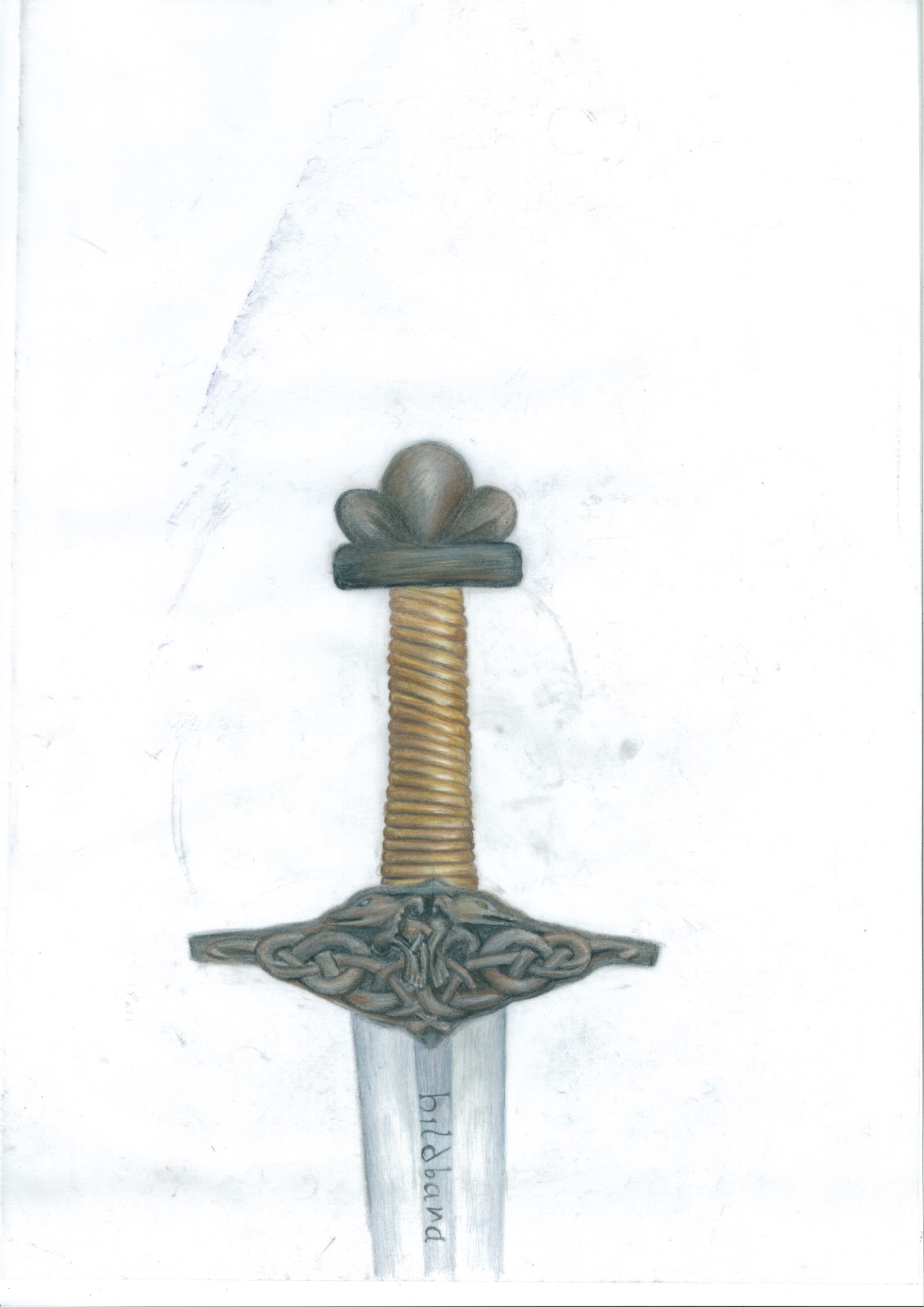
Wulfhere stands on the crest of the hill and stares in horror at the terrible carnage surrounding him. He surveys the scene with blurred vision. Body parts are scattered indiscriminately. As his eyes clear, he sees that they are set about the bloody slope in congealed masses. His byrnie feels unbearably heavy. Sweat trickles down his skin in rivulets. Instinctively, he clasps his sword, Hildbana, as the perspiration runs from under his sleeve and into his palm. But his hand is soaked and he cannot hold on to it, and the weapon slips down the slope.

The sky is dense with dark clouds. The mist-ridden air is dank with the stench of death and blood. He feels dizzy and wants to gag. Instead he forces himself to breathe, breathe hard, to avoid expelling the bile that rises in his throat.

“Pick up your sword, Lord Wulfhere!” urges a familiar voice.

A terrible throbbing pounds at his temple and he fights his desire to lose consciousness. “I cannot find it…”

“You must!” the voice shouts at him in earnest.

Wulfhere staggers down the hill, recognising the faces of his fallen comrades on the severed heads that he passes by. They speak to him through lips that do not move; words he cannot discern. His feet are slipping in the oozing blood and he feels his heart racing. The voice continues to order him to find his sword. Below him, at the foot of the hill, he sees a morass of jumbled men and spears. His head throbs as he moves toward them, fearing that his sword is lost somewhere amongst the chaos.

Suddenly, he is in the midst of the growling shield wall. The sound of battle deafens him as he is heaved, pushed and stabbed at with spears or axes. The enemy are in front. Snarling wolf-like faces. The points of their spears jab at him. Wooden shields slam into the phalanx, trying to break their way in. Wulfhere is jostled this way and that, as if he is a coracle tossed in a stormy sea. He wants his sword. How can he fight without his sword?

“Where is my sword? Where is Hildbana?”he hears himself shout and, though he knows it is his voice, it feels as if it has come from another.

His head spins. He stares down in an attempt to avoid passing out and sees that his feet are bare and the air is freezing against his naked body. Where is his armour?

Terror grasps at his insides and fear tears through his veins. He is naked. No spear, no sword, no armour to protect him…

“My lord, your sword!” he hears the voice shout again. “Where is your sword?”

He looks up from the ground and stares into faces that are no longer fleshy. Faces of bone. Skeletons wearing dark hoods. He screams...a long, agonising cry that is eventually broken by the familiar voice calling him again.

“My lord! Open your eyes! Can you hear me?”
"I know that voice. Esegar!"
He is pulled by his ankles out of the scrum of the shield wall.
“My lord! ’Tis I, Esegar! Can you hear me?”

Wulfhere lies on the grass, dazed, tries to sit up. His helmet is gone and his head pounds. Around him he hears the screams and roars of the men in the shield wall; the agonising sound of men dying.

“Here, take your sword!”
“You have it?” Wulfhere asks. Relief overwhelms him. He is alive and Esegar has found his sword. He must have passed out.
Esegar’s face flashes above him and Wulfhere feels reassured. Then, almost as quickly as it has appeared, the flesh begins to deteriorate, leaving a mass of hideously rotting flesh, until it is no longer Esegar hovering above him, but the hooded figure of death surrounded by darkness.

Death smiles; a repugnant grim contortion of the jawbone drops open to spill forth evil laughter and, with it, disgusting creatures, bugs, worms and all kinds of ghastly things from hell.

“Your sword is broken, my lord,” the face of death says, rasping and mocking like the voice of an old harridan. A pair of bony hands hold forth his beloved Hildbana, Battle Slayer, the sword that has been handed down to him from his father…it is broken in two.

Wulfhere is lifted to his feet, as if by unseen hands. A scream is rising within him as the world around him spins. The scream pierces through his brain as if his head will break open and scatter its contents in an explosion of agony. Unable to breathe or move, his whole body is paralysed. The noise inside his head grows louder until it reaches a crescendo and, suddenly, he forces his eyes open and breathes in a heavy gasp.